Your Sensory System- Are You Listening?
If you’ve ever walked into a supermarket and instantly felt overwhelmed…
If certain clothes feel unbearable on some days but “fine” on others…
If noise, lights, or busy environments leave you exhausted in ways others don’t seem to understand…
There’s a good chance your nervous system is doing exactly what it was designed to do — protect you, process your world, and try to keep you safe.
Sensory processing isn’t just a childhood issue.
It’s not a flaw.
And it’s definitely not something that needs to be “fixed.”
For many Autistic and ADHD adults, sensory processing differences are a core part of how you experience the world and understanding this can be deeply enlightening.
What is sensory processing (really)?
Sensory processing is how your brain and nervous system receive, interpret, and respond to information from your body and environment.
That includes:
Sound
Light
Touch and texture
Movement and balance
Body awareness
Internal sensations like hunger, pain, or fatigue (also called “interoception”)
Your sensory system is constantly asking:
“Is this safe? Is this too much? Is this enough?”
When you live in a world that isn’t designed for your nervous system, that question can feel loud all day, every day.
The “sensory cup”: a helpful way to understand your capacity
One way to think about sensory processing is using a sensory cup analogy (as shown in the image above).
Your cup represents your nervous system’s capacity to take in sensory input.
How full your cup is can change depending on:
Stress
Sleep
Masking
Emotional load
Illness
Demands at work or home
When your cup is already full, even small sensory input can tip you over.
This is why:
That necklace you love might suddenly feel unbearable on a stressful day
Supermarket shelves feel impossible to scan when you’re already overloaded
Noise that you normally tolerate suddenly feels threatening
Social events leave you completely wiped out
It’s not weakness.
It’s nervous system maths.
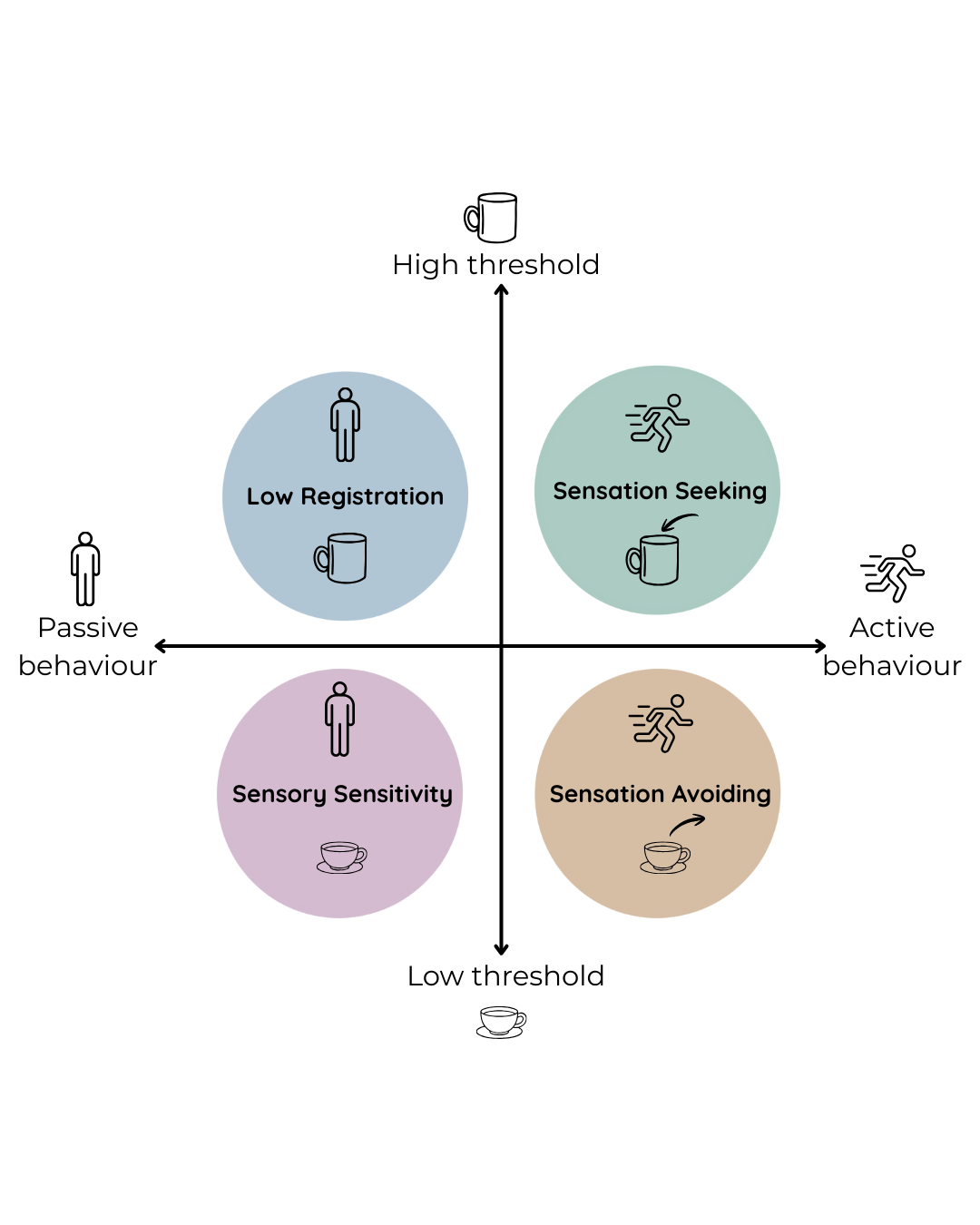
Sensory Profile Quadrants
The four common sensory patterns (and why none are “wrong”)
Most people have a mix, but you may lean more strongly into one or two patterns:
Low Registration (high threshold, passive)
You might:
Miss cues
Not notice things until they’re intense
Feel “flat” or disconnected
Need more input to feel alert
Others may say you’re “not paying attention” when actually your nervous system needs more input to register.
Sensation Seeking (high threshold, active)
You might:
Crave movement, pressure, or stimulation
Fidget, pace, or multitask
Seek strong sensory input to feel regulated
This isn’t being “too much.”
It’s your nervous system saying: I need more to feel balanced.
Sensory Sensitivity (low threshold, passive)
You might:
Notice everything
Feel easily overwhelmed
Be deeply affected by noise, light, texture, or smells
Fatigue quickly in busy environments
Your system is highly attuned- not fragile.
Sensory Avoiding (low threshold, active)
You might:
Actively reduce sensory input
Avoid certain environments
Control clothing, lighting, or sound
Need predictability to feel safe
This is your nervous system advocating for itself.

Masking, burnout, and sensory load
Many Autistic and ADHD adults spend years masking… pushing through discomfort, tolerating overload, and trying to appear “fine.”
Over time, this can lead to:
Chronic fatigue
Emotional shutdown
Sensory burnout
Reduced tolerance for things you once managed
This isn’t you “getting worse.”
It’s your nervous system saying: I’ve been carrying too much for too long.
Sensory needs are not preferences — they are nervous system supports
Dimming lights.
Wearing noise-cancelling headphones.
Choosing certain fabrics.
Taking movement breaks.
Reducing visual clutter.
These are not indulgences.
They are reasonable accommodations for a differently wired nervous system.
When your sensory needs are supported, your capacity for:
Focus
Learning
Emotional regulation
Energy
Social connection
Work performance
often improves dramatically.
How occupational therapy can help (neuroaffirming, not “fixing”)
Neuroaffirming OT is not about making you tolerate more.
It’s about helping you understand your sensory system, support your nervous system, and build a life that works with your wiring- not against it.
That might include:
Understanding your sensory profile
Reducing sensory overload at work and home
Supporting nervous system safety
Identifying accommodations that actually help
Reframing sensory needs with self-compassion
Reducing burnout and sensory fatigue
The goal isn’t to change you.
The goal is to help you live with less friction and more safety in your nervous system.
You’re not “too sensitive.” You’re perceptive.
If you’ve spent years being told you’re:
Too sensitive
Too fussy
Too much
Not resilient enough
Here’s a gentler reframe:
Your nervous system is doing its job.
It just lives in a world that wasn’t built with your sensory needs in mind.
Understanding your sensory processing isn’t about labels.
It’s about self-understanding, validation, and permission to support yourself differently.
Curious about how your sensory system works — and how to support it?
If you’re an Autistic or ADHD adult wanting to better understand your sensory profile, reduce sensory burnout, and build practical strategies that actually fit your life, occupational therapy can help.
✨ Book an OT session at Wise Mind OT to explore your sensory processing preferences now.